Nemo  2.4.1
Simulate forward-in-time genetic evolution in a spatially explicit, individual-based stochastic simulator
GeneticMap Class Reference

GeneticMap. More...

#include <ttrait_with_map.h>

+ Collaboration diagram for GeneticMap:

Public Member Functions

 GeneticMap ()
 
 ~GeneticMap ()
 
bool getGeneticMap (trait_t trait, double **table, unsigned int table_length)
 
double getResolution ()
 
double setResolution (double val)
 
void rescaleMap (double val)
 
void reset_tables ()
 
void clear ()
 
void setLookupTable (unsigned int idx)
 Bbuilds the lookup table for each trait. More...
 
void recombine (sex_t SEX)
 Called by TTProtoWithMap::recombine twice to create the two gametes necessary for the creation of a new individual. More...
 
void placeRecombinationEvents (sex_t SEX, vector< unsigned int > junctions, const vector< bool > &firstRecPos)
 Deterministic counterpart of recombine(sex_t): instead of drawing the x-over map positions and per-chromosome start sides at random, they are supplied by the caller. More...
 
void placeRecombinationEvents (sex_t SEX)
 Shared no-allocation core of recombine()/placeRecombinationEvents(): maps the x-over positions already stored in the member _junctions to per-trait locus indices (dedup + lookup-table mapping + trailing-gap/boundary skip + sentinel), filling _recPositions[SEX]. More...
 
vector< pair< unsigned int, unsigned int > > reduceJunctions (sex_t SEX, unsigned int trait_idx)
 Remove multiple x-over at the same locus when traits differ in number of loci. More...
 
bool registerIndForRecombine (unsigned long ID)
 Called by TTProtoWithMap::recombine with individual ID passed down from Individual::recombine. More...
 
unsigned int addTrait (trait_t trait, unsigned int nChrm, unsigned int nLoc, unsigned int *nLocChrm, double resolution, unsigned int *locPositions)
 Returns the table index for the registered trait. More...
 
void unregisterTrait (trait_t trait)
 
bool checkRegisteredTrait (trait_t trait)
 Returns true if trait 'trait' has registered a genetic map, false otherwise. More...
 
vector< unsigned int > & getRecLoci (sex_t SEX, unsigned int trait)
 Returns a vector of the loci where crossing-overs take place. More...
 
vector< bool > & getFirstRecPosition (sex_t SEX)
 Returns the vector of the first chromosome position for recombination, used for all traits. More...
 
unsigned int * getLocusPositionTable (const trait_t trait)
 

Private Attributes

unsigned long _currentIndividual
 
map< trait_t, unsigned int > _traits
 Table mapping trait type to its position index in the following tables. More...
 
unsigned int _nTrait
 Number of traits registered in the map. More...
 
vector< unsigned int * > _lociLookupTable
 A list of tables that map the map position (cM) to a locus, for each trait. More...
 
vector< unsigned int > _numChrsmPerTrait
 Vector of number of chromosomes for each trait. More...
 
vector< unsigned int > _numLociPerTrait
 Vector of number of loci for each trait. More...
 
vector< unsigned int * > _numLociPerChrsmPerTrait
 Vector containing a table of number of loci per chromosome for each trait. More...
 
vector< unsigned int * > _locPositionsPerTrait
 Vector containing the table of map position for the loci of each trait. More...
 
vector< vector< unsigned int > > _recPositions [2]
 Vector of tables containing, for each trait, the locus number at which x-overs happen. More...
 
vector< bool > _chrsmFirstRecombPosition [2]
 Two vectors holding the starting copy of each chromosome to use when creating the two gametes that are used to create a new individual. More...
 
vector< unsigned int > _junctions
 A vector to store the position of the recombination events. More...
 
unsigned int _numChromosome
 
unsigned int * _perChrsmLength
 
unsigned int * _chrsmFirstLocusPosition
 
unsigned int _totalLength
 
unsigned int _recombLength
 
unsigned int _totalNumLoci
 
double _resolution
 
double _totRecombEventsMean
 
double _recombinationRate
 

Detailed Description

Constructor & Destructor Documentation

◆ GeneticMap()

GeneticMap::GeneticMap ( )
inline
unsigned int _nTrait
Number of traits registered in the map.
Definition: ttrait_with_map.h:55
unsigned int _recombLength
Definition: ttrait_with_map.h:87
double _recombinationRate
Definition: ttrait_with_map.h:91
double _totRecombEventsMean
Definition: ttrait_with_map.h:90
unsigned int * _chrsmFirstLocusPosition
Definition: ttrait_with_map.h:85
unsigned int _totalLength
Definition: ttrait_with_map.h:86
unsigned int * _perChrsmLength
Definition: ttrait_with_map.h:84
unsigned int _numChromosome
Definition: ttrait_with_map.h:83
unsigned int _totalNumLoci
Definition: ttrait_with_map.h:88
double _resolution
Definition: ttrait_with_map.h:89
unsigned long _currentIndividual
Definition: ttrait_with_map.h:49

◆ ~GeneticMap()

GeneticMap::~GeneticMap ( )
inline
101 {reset_tables();}
void reset_tables()
Definition: ttrait_with_map.cc:1404

References reset_tables().

Member Function Documentation

◆ addTrait()

unsigned int GeneticMap::addTrait ( trait_t  trait,
unsigned int  nChrm,
unsigned int  nLoc,
unsigned int *  nLocChrm,
double  resolution,
unsigned int *  locPositions 
)

Returns the table index for the registered trait.

696 {
697  map<trait_t, unsigned int>::iterator tIter;
698 
699  unsigned int traitIdx = 0;
700 
701  bool do_add = true;
702 
703  tIter = _traits.find(trait);
704 
705  if ( tIter != _traits.end() ) {
706  //this shouldn't happen... unless we are loading a pop from source!!
707 
708  traitIdx = tIter->second;
709 
710  if(_numChrsmPerTrait[traitIdx] != nChrm)
711  fatal("mismatch while loading source population and resetting genetic map for trait \"%s\" \n\
712 >>>>> number of chromosomes differ (%i != %i)\n\
713 >>>>> please check match between init file and source population\n",trait.c_str(),_numChrsmPerTrait[traitIdx],nChrm);
714 
715  if(_numLociPerTrait[traitIdx] != nLoc)
716  fatal("mismatch while loading source population and resetting genetic map for trait \"%s\"\n\
717 >>>>> number of loci differ (%i != %i)\n\
718 >>>>> please check match between init file and source population\n",trait.c_str(),_numLociPerTrait[traitIdx], nLoc);
719 
720  unsigned int *locTable = _numLociPerChrsmPerTrait[traitIdx];
721 
722  for (unsigned int i=0; i<nChrm; i++)
723  if(locTable[i] != nLocChrm[i])
724  fatal("mismatch while loading source population and resetting genetic map for trait \"%s\"\n\
725 >>>>> number of loci differ (%i != %i) on chromosome %i\n\
726 >>>>> please check match between init file and source population\n",trait.c_str(),locTable[i], nLocChrm[i], i+1);
727 
728  do_add = false;
729 
730  }
731 
732 #if defined(_DEBUG_)
733  cout << "GeneticMap::addTrait: \n";
734  cout << " _numChromosome = "<<nChrm<<endl;
735  cout << " _totalNumLoci = "<<_totalNumLoci<<endl;
736  cout << " _resolution = "<<_resolution<<endl;
737  cout << " _totalLength = "<<_totalLength<<endl;
738  cout << ":::"<<trait<<"::: params:\n";
739  cout << " num chromosome = "<<nChrm<<endl;
740  cout << " num loci = "<<nLoc<<endl;
741  cout << " map resolution = "<<resolution<<endl;
742 #endif
743 
744  if (_nTrait == 0) { //this is the first trait to register its map
745 
746  _numChromosome = nChrm;
747  _totalNumLoci = nLoc;
748  _resolution = resolution;
749  _totalLength = locPositions[nLoc-1];
750 
751  //destroy all previously allocated tables
752  reset_tables();
753 
754  _perChrsmLength = new unsigned int[_numChromosome];
755  _chrsmFirstLocusPosition = new unsigned int[_numChromosome];
756 
757  } else {
758  //we have already registered some trait's genetic map, we append this trait's info and update the map
759 
760  if (nChrm != _numChromosome) //check chromosome numbers
761  fatal("Traits in init file don't have same number of chromosomes, cannot set the genetic map!\n");
762 
763  //number of loci
764  _totalNumLoci = max(_totalNumLoci, nLoc);
765 
766  //setting the resolution:
767  if (resolution < _resolution) {
768 
769 // cout << "GeneticMap::addTrait: rescaling map resolution (old "<< _resolution << "; new "<< resolution<< ")\n";
770 
771  rescaleMap(resolution);
772 
773  } else if (resolution > _resolution) {
774 
775 // cout << "GeneticMap::addTrait: rescaling locus position (old "<< _resolution << "; new "<< resolution<< "; ratio "<< resolution/_resolution <<")\n";
776 
777  double ratio = resolution/_resolution;
778 
779  for(unsigned int i = 0; i < nLoc; ++i)
780  locPositions[i] = (unsigned int)((double)locPositions[i]*ratio);
781  }
782 
783  }
784 
785  if(do_add) { //only at the start of a simulation, not when loading pop from binary source
786 
787  traitIdx = _nTrait;
788 
789  _traits[trait] = _nTrait++;
790 
791 
792  //---- record num chrmsm
793  if ( _numChrsmPerTrait.size() != _nTrait -1 ) {
794  fatal("Genetic map::wrong size of table of num chrms per trait (%i != %i)",
795  _numChrsmPerTrait.size(), _nTrait -1);
796  } else
797  _numChrsmPerTrait.push_back(nChrm);
798 
799  //---- record num loci
800  if ( _numLociPerTrait.size() != _nTrait -1 ) {
801  fatal("Genetic map::wrong size of table of num loci per trait (%i != %i)",
802  _numLociPerTrait.size(), _nTrait -1);
803  } else
804  _numLociPerTrait.push_back(nLoc);
805 
806  //---- record table of num loci per chrmsm
807  if ( _numLociPerChrsmPerTrait.size() != _nTrait -1 )
808  fatal("Genetic map::wrong size of table of num loci per chrms per trait (%i != %i)",
810 
811  unsigned int* locTable = new unsigned int[nChrm];
812 
813  for (unsigned int i = 0; i < nChrm; i++) locTable[i] = nLocChrm[i];
814 
815  _numLociPerChrsmPerTrait.push_back(locTable);
816 
817  //---- record the locus positions
818  if ( _locPositionsPerTrait.size() != _nTrait -1 ) {
819  fatal("Genetic map::wrong size of table of loc position per trait (%i != %i)",
820  _locPositionsPerTrait.size(), _nTrait-1);
821  }
822 
823  //copy the locus positions, they are at the correct resolution already
824  unsigned int* posTable = new unsigned int[nLoc];
825 
826  for (unsigned int i = 0; i < nLoc; ++i) {
827  posTable[i] = locPositions[i];
828  }
829 
830  _locPositionsPerTrait.push_back(posTable);
831 
832 
833  //---- create tables to record positions of x-over, for each gamete (male and female)
834 
835  for(unsigned int s = 0; s < 2; ++s){
836  if ( _recPositions[s].size() != _nTrait -1 )
837  fatal("Genetic map::wrong size of rec positions table (%i != %i)",
838  _recPositions[s].size(), _nTrait-1);
839 
840  _recPositions[s].push_back(vector<unsigned int>()); //add an empty array for each trait
841  }
842 
843 
844  //---- set the map positions according to other trait's
845  //---- need to correctly set starting position and length of each chromosome
846 
847  if (_nTrait == 1) { //first trait to register
848 
849  for (unsigned int c = 0, stride = 0; c < _numChromosome; ++c) {
850  _chrsmFirstLocusPosition[c] = locPositions[stride];
851  _perChrsmLength[c] = locPositions[stride + nLocChrm[c] - 1] - locPositions[stride]; //position of last locus - position of first locus on that chromosome.
852  stride += nLocChrm[c];
853  }
854 
855  } else {
856 
857  for (unsigned int c = 0, lastPos, stride = 0; c < _numChromosome; ++c) {
858 
859  lastPos = max(locPositions[stride + nLocChrm[c] - 1],
861 
862  _chrsmFirstLocusPosition[c] = min(_chrsmFirstLocusPosition[c], locPositions[stride]);
863 
864  _perChrsmLength[c] = lastPos - _chrsmFirstLocusPosition[c];
865 
866  stride += nLocChrm[c];
867  }
868  }
869 
870  //---- compute total chromosome length
871  _totalLength = 0;
872  for (unsigned int c = 0; c < _numChromosome; ++c) _totalLength += _perChrsmLength[c];
873 
874  //---- mean num recombination events, map length of 1M = 1 x-over on average
875  _totRecombEventsMean = (double)_totalLength * 0.01 * _resolution;
876 
877  //---- set the map size used to draw recombination spots; one less operation in recombine()...
879 
880  //---- set the recombination rate between adjacent positions on the map;
882 
883 
884 #if defined(_DEBUG_) or defined(_REC_DEBUG_)
885  cout << "GeneticMap::addTrait: "<<endl;
886  cout << " map stats for trait \""<<trait<<"\" at "<<traitIdx<<"\n";
887  cout << " _totalLength = "<<_totalLength<<endl;
888  cout << " _totRecombEventsMean = "<<_totRecombEventsMean<<endl;
889 #endif
890 
891  if(_totalLength > 9e+8)
892  warning("Your genetic map is larger than %.2fcM with %i elements, you may experience memory allocation problems\
893  as well as problems at runtime.\n",
895 
896  //---- create new slot for the lookup table of that trait
897  // will be allocated and filled in setLookupTable
898  if ( _lociLookupTable.size() != _nTrait -1 )
899  fatal("Genetic map::wrong size of loci lookup tables (%i != %i)",
900  _lociLookupTable.size(), _nTrait-1);
901 
902  _lociLookupTable.push_back(NULL);
903 
904  //---- set all lookup tables (all genetic maps):
905  // we reset all tables each time a trait is added because _totalLength changes
906  for (unsigned int t = 0; t < _nTrait; ++t) setLookupTable(t);
907  }
908 
909 #if defined(_DEBUG_) or defined(_REC_DEBUG_)
910  cout << "GeneticMap::addTrait: "<<endl;
911  cout << " traits in table:\n";
912  map<trait_t, unsigned int>::const_iterator tt_it = _traits.begin();
913  while(tt_it != _traits.end()) {
914  cout << " ["<<tt_it->second<<"] "<<tt_it->first<<endl;
915  tt_it++;
916  }
917 #endif
918 
919  return traitIdx;
920 }
void setLookupTable(unsigned int idx)
Bbuilds the lookup table for each trait.
Definition: ttrait_with_map.cc:983
vector< unsigned int > _numLociPerTrait
Vector of number of loci for each trait.
Definition: ttrait_with_map.h:64
vector< unsigned int * > _lociLookupTable
A list of tables that map the map position (cM) to a locus, for each trait.
Definition: ttrait_with_map.h:60
vector< unsigned int > _numChrsmPerTrait
Vector of number of chromosomes for each trait.
Definition: ttrait_with_map.h:62
vector< unsigned int * > _locPositionsPerTrait
Vector containing the table of map position for the loci of each trait.
Definition: ttrait_with_map.h:69
vector< vector< unsigned int > > _recPositions[2]
Vector of tables containing, for each trait, the locus number at which x-overs happen.
Definition: ttrait_with_map.h:74
vector< unsigned int * > _numLociPerChrsmPerTrait
Vector containing a table of number of loci per chromosome for each trait.
Definition: ttrait_with_map.h:66
map< trait_t, unsigned int > _traits
Table mapping trait type to its position index in the following tables.
Definition: ttrait_with_map.h:52
void rescaleMap(double val)
Definition: ttrait_with_map.cc:954
void fatal(const char *str,...)
Definition: output.cc:99
void warning(const char *str,...)
Definition: output.cc:57

References _chrsmFirstLocusPosition, _lociLookupTable, _locPositionsPerTrait, _nTrait, _numChromosome, _numChrsmPerTrait, _numLociPerChrsmPerTrait, _numLociPerTrait, _perChrsmLength, _recombinationRate, _recombLength, _recPositions, _resolution, _totalLength, _totalNumLoci, _totRecombEventsMean, _traits, fatal(), rescaleMap(), reset_tables(), setLookupTable(), and warning().

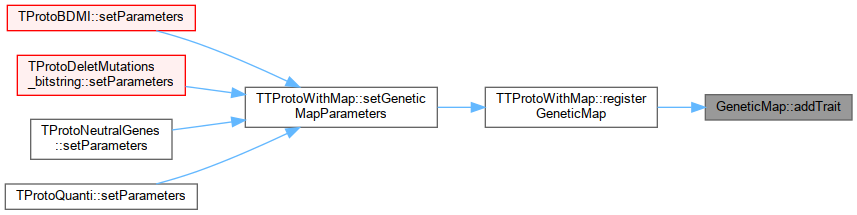
Referenced by TTProtoWithMap::registerGeneticMap().

+ Here is the caller graph for this function:
◆ checkRegisteredTrait()

bool GeneticMap::checkRegisteredTrait ( trait_t  trait)

Returns true if trait 'trait' has registered a genetic map, false otherwise.

Parameters
traitThe trait name to check for in the trait table.
674 {
675  map<trait_t, unsigned int>::iterator tIter = _traits.find(trait);
676 
677  return ( tIter != _traits.end() );
678 }

References _traits.

Referenced by TTProtoWithMap::is_mapped(), and TTQuantiFH::setOutputOption().

+ Here is the caller graph for this function:

◆ clear()

void GeneticMap::clear ( )
683 {
684  reset_tables();
685  _traits.clear();
686  _nTrait = 0;
687 }

References _nTrait, _traits, and reset_tables().

Referenced by IndFactory::clearPrototype().

+ Here is the caller graph for this function:

◆ getFirstRecPosition()

vector< bool >& GeneticMap::getFirstRecPosition ( sex_t  SEX)
inline

Returns the vector of the first chromosome position for recombination, used for all traits.

191  { return _chrsmFirstRecombPosition[SEX]; }
vector< bool > _chrsmFirstRecombPosition[2]
Two vectors holding the starting copy of each chromosome to use when creating the two gametes that ar...
Definition: ttrait_with_map.h:78

References _chrsmFirstRecombPosition.

◆ getGeneticMap()

bool GeneticMap::getGeneticMap ( trait_t  trait,
double **  table,
unsigned int  table_length 
)
925 {
926  map< trait_t, unsigned int>::const_iterator ITER = _traits.find(trait);
927 
928  if(ITER == _traits.end())
929  return(error("GeneticMap::getGeneticMap::failed to find trait \"%s\" in genetic map\n", trait.c_str()));
930 
931  unsigned int idx = ITER->second;
932 
933  assert(table_length == _numLociPerTrait[idx]);
934 
935  unsigned int chr = 0, loc_cnt = _numLociPerChrsmPerTrait[idx][0];
936 
937  for(unsigned int i = 0; i < table_length; ++i) {
938 
939  if(i >= loc_cnt) {
940  chr++;
941  loc_cnt += _numLociPerChrsmPerTrait[idx][chr];
942  }
943 
944  table[0][i] = chr;
945  table[1][i] = _locPositionsPerTrait[idx][i];
946 
947  }
948 
949  return true;
950 }
int error(const char *str,...)
Definition: output.cc:78

References _locPositionsPerTrait, _numLociPerChrsmPerTrait, _numLociPerTrait, _traits, and error().

Referenced by GenotyperFH::FHwrite(), GenotyperFH::print_PLINK(), TTNeutralGenesFH::write_PLINK(), and TTQuantiFH::write_PLINK().

+ Here is the caller graph for this function:

◆ getLocusPositionTable()

unsigned int* GeneticMap::getLocusPositionTable ( const trait_t  trait)
inline
194  {return _locPositionsPerTrait[ _traits[ trait ] ];}

References _locPositionsPerTrait, and _traits.

Referenced by TTProtoWithMap::get_locus_map_positions().

+ Here is the caller graph for this function:

◆ getRecLoci()

vector< unsigned int>& GeneticMap::getRecLoci ( sex_t  SEX,
unsigned int  trait 
)
inline

Returns a vector of the loci where crossing-overs take place.

185  {
186  return _recPositions[SEX][trait];
187  }

References _recPositions.

◆ getResolution()

double GeneticMap::getResolution ( )
inline
105 {return _resolution;}

References _resolution.

Referenced by TTProtoWithMap::recordRandomMap().

+ Here is the caller graph for this function:

◆ placeRecombinationEvents() [1/2]

void GeneticMap::placeRecombinationEvents ( sex_t  SEX)

Shared no-allocation core of recombine()/placeRecombinationEvents(): maps the x-over positions already stored in the member _junctions to per-trait locus indices (dedup + lookup-table mapping + trailing-gap/boundary skip + sentinel), filling _recPositions[SEX].

It does NOT set _chrsmFirstRecombPosition: each caller sets the per-chromosome start copies itself (recombine() draws them, the deterministic overload copies them from firstRecPos).

1196 {
1197  //empty the array of x-over positions
1198  for (unsigned int t = 0; t < _nTrait; t++) {
1199  _recPositions[SEX][t].clear();
1200  }
1201 
1202  //_junctions are assumed in range [0,_totalLength]: the random path (recombine) draws them
1203  //that way by construction and only calls this when nbRec>0; the deterministic entry point
1204  //clamps untrusted input before calling. So no per-gamete bounds scan happens here.
1205 
1206  unsigned int nbRec = _junctions.size();
1207 
1208  //now determine where the x-over will take place
1209  if(nbRec > 0) {
1210 
1211  //sort the positions
1212  sort(_junctions.begin(), _junctions.end());
1213 
1214 #ifdef _REC_DEBUG_
1215  cout<< " --- sorted junctions ("<< _junctions.size()<<"): ";
1216  auto print = [](unsigned int& n){cout<<" "<<n;};
1217  for_each(_junctions.begin(), _junctions.end(), print);
1218  cout<<endl;
1219 #endif
1220 
1221  //remove the duplicates, we keep only one when that happens (in principle very rarely):
1222  auto last = unique(_junctions.begin(), _junctions.end());
1223 
1224 
1225  // UPDATE NUMBER OF RECOMBINATION EVENTS
1226 
1227  nbRec = last - _junctions.begin(); // these are the unique x-over map positions
1228 
1229 #ifdef _REC_DEBUG_
1230  cout<<" --- after removing duplicates ("<< last - _junctions.begin()<<"): ";
1231  for_each(_junctions.begin(), last, print);
1232  cout<<endl;
1233 
1234  cout<<" --- computing rec map position: \n";
1235 #endif
1236 
1237  size_t pos;
1238 
1239  // chromosome of a contiguous map position. A boundary coordinate B_c is shared by
1240  // chromosome c-1's max-position locus and chromosome c's min-position locus;
1241  // setLookupTable fills B_c during chromosome c-1's loop (its bound is inclusive:
1242  // pos <= _perChrsmLength[c-1]), so B_c belongs to the LOWER chromosome. We must use
1243  // the SAME convention here ("<=", not "<"): otherwise a crossover landing exactly on
1244  // B_c is classified as chromosome c here but mapped to chromosome c-1's last locus by
1245  // the lookup, and traits disagree on which chromosome it belongs to -> desync at the
1246  // sparse trait's first locus of the next chromosome.
1247  auto chromOfPos = [this](size_t p) -> unsigned int {
1248  unsigned int end = 0;
1249  for (unsigned int c = 0; c < _numChromosome; ++c) {
1250  end += _perChrsmLength[c];
1251  if (p <= end) return c;
1252  }
1253  return (_numChromosome ? _numChromosome - 1 : 0);
1254  };
1255 
1256  for (unsigned int t = 0; t < _nTrait; t++) {
1257 
1258  // chromosome of a locus index for trait t; the sentinel region (loc past the
1259  // last locus of the last chromosome) returns _numChromosome.
1260  auto chromOfLocus = [this, t](unsigned int loc) -> unsigned int {
1261  unsigned int end = 0;
1262  for (unsigned int c = 0; c < _numChromosome; ++c) {
1263  end += _numLociPerChrsmPerTrait[t][c];
1264  if (loc < end) return c;
1265  }
1266  return _numChromosome;
1267  };
1268 
1269 #ifdef _REC_DEBUG_
1270  cout<<" trait "<< t << endl;
1271 #endif
1272 
1273  for(unsigned int i = 0, hit; i < nbRec; ++i) {
1274 
1275  pos = _junctions[i];
1276 
1277  hit = _lociLookupTable[t][pos];
1278 
1279  // A crossover that falls on chromosome c but past this trait's LAST locus on c
1280  // (its "trailing gap") maps to cStart(c+1), i.e. a locus on a LATER chromosome
1281  // than the crossover itself. Such a crossover is a no-op for this trait and must
1282  // NOT be recorded: otherwise reduceJunctions' zip-forward would mis-account it as
1283  // a flip of chromosome c+1 and decouple this trait from the others across that
1284  // whole chromosome. (Mirror of the leading-gap case handled in reduceJunctions.)
1285  if ( chromOfLocus(hit) > chromOfPos(pos) ) {
1286 #ifdef _REC_DEBUG_
1287  cout<< " ["<<i<<"] @"<<pos<<" -> loc "<< hit <<" SKIPPED (trailing gap on chrm "
1288  << chromOfPos(pos) <<")\n";
1289 #endif
1290  continue;
1291  }
1292  _recPositions[SEX][t].push_back( hit );
1293 
1294 
1295 #ifdef _REC_DEBUG_
1296  cout<< " ["<<i<<"] @"<<pos<<" -> loc "<< hit <<"\n";
1297 #endif
1298 
1299  }// end_for_bRec
1300  }// end_for_traits
1301  } // end_if_nbRec
1302 
1303  // we always add the last position possible, to avoid returning an empty vector
1304  for (unsigned int t = 0; t < _nTrait; t++) {
1305  _recPositions[SEX][t].push_back(_numLociPerTrait[t]);
1306  }
1307 
1308 
1309 }
vector< unsigned int > _junctions
A vector to store the position of the recombination events.
Definition: ttrait_with_map.h:81

References _junctions, _lociLookupTable, _nTrait, _numChromosome, _numLociPerChrsmPerTrait, _numLociPerTrait, _perChrsmLength, and _recPositions.

◆ placeRecombinationEvents() [2/2]

void GeneticMap::placeRecombinationEvents ( sex_t  SEX,
vector< unsigned int >  junctions,
const vector< bool > &  firstRecPos 
)

Deterministic counterpart of recombine(sex_t): instead of drawing the x-over map positions and per-chromosome start sides at random, they are supplied by the caller.

The SAME dedup + per-trait lookup-table mapping + sentinel logic is then applied, so the resulting GeneticMap::_recPositions are identical to what recombine() would have produced for those same draws. Used by tests/tools to reproduce an exact gamete.

Parameters
SEXthe origin of the gamete
junctionscrossover positions in contiguous map coordinates, in 0,_totalLength
firstRecPoswhich parental chromosome copy each chromosome starts with (size must be _numChromosome)
1168 {
1169  //adopt the caller-supplied positions into the reusable member.
1170  _junctions.swap(junctions);
1171 
1172  //sanitise untrusted input: clamp out-of-range positions (the lookup table has
1173  //_totalLength+1 elements, so the largest valid index is _totalLength). The random
1174  //hot path skips this because its draws are in range by construction.
1175  for (unsigned int& n : _junctions) {
1176  if (n > _totalLength) {
1177  warning("GeneticMap::placeRecombinationEvents: junction position %i out of range "
1178  "(map length %i), clamping.\n", n, _totalLength);
1179  n = _totalLength;
1180  }
1181  }
1182 
1183  //run the shared core (same dedup + lookup + sentinel mapping as the random hot path).
1185 
1186  //set the starting copy for each chromosome from the supplied values
1187  _chrsmFirstRecombPosition[SEX].assign(_numChromosome, 0); //re-initialise the array
1188  for(unsigned int c = 0; c < _numChromosome && c < firstRecPos.size(); ++c) {
1189  _chrsmFirstRecombPosition[SEX][c] = firstRecPos[c];
1190  }
1191 }
void placeRecombinationEvents(sex_t SEX, vector< unsigned int > junctions, const vector< bool > &firstRecPos)
Deterministic counterpart of recombine(sex_t): instead of drawing the x-over map positions and per-ch...
Definition: ttrait_with_map.cc:1166

References _chrsmFirstRecombPosition, _junctions, _numChromosome, _totalLength, and warning().

Referenced by recombine().

+ Here is the caller graph for this function:

◆ recombine()

void GeneticMap::recombine ( sex_t  SEX)

Called by TTProtoWithMap::recombine twice to create the two gametes necessary for the creation of a new individual.

This function sets the location of the x-over on the chromosome map and records the loci positions at which x-over happen for each trait separately. The positions are stored in GeneticMap::_recPositions, which are then passed to the trait-specific inheritance functions when setting up the genetics of the traits in new individuals.

Parameters
SEXthe origin of the gamete, whether from the father or the mother
1116 {
1117  unsigned int nbRec = 0;
1118 
1119 
1120 
1121  //create a gamete:
1122 
1123  //draw the number of x-over depending on the total map size
1124  nbRec = (unsigned int)RAND::Poisson( _totRecombEventsMean );
1125 
1126 
1127 #ifdef _REC_DEBUG_
1128  cout << "\n@@@ GeneticMap::recombine( SEX = "<<SEX<<" nbRec = "<<nbRec<<")"<<endl;
1129 #endif
1130 
1131  //adjust
1132  if(nbRec > _totalNumLoci - 1) nbRec = _totalNumLoci - 1;
1133 
1134  if(nbRec > 0) {
1135 
1136  //draw where the x-over will take place (contiguous map positions) into the reusable
1137  //_junctions buffer; resize() keeps the previously allocated capacity, so no per-gamete
1138  //heap allocation happens after warm-up. The draw is in range [0,_totalLength] by
1139  //construction (Uniform() < 1, _recombLength == _totalLength + 1), so no clamp is needed.
1140  _junctions.resize(nbRec);
1141  for (unsigned int& n : _junctions)
1142  n = (unsigned int)(RAND::Uniform() * _recombLength);
1143 
1144  //map the drawn positions to per-trait loci (clears _recPositions, dedup + lookup, sentinel)
1146 
1147  } else {
1148 
1149  //common case (no crossover, the majority of gametes on a short map): just clear and
1150  //append the end sentinel for each trait, skipping the buffer/dedup/lookup machinery and
1151  //the extra function call entirely.
1152  for (unsigned int t = 0; t < _nTrait; t++) {
1153  _recPositions[SEX][t].clear();
1154  _recPositions[SEX][t].push_back(_numLociPerTrait[t]);
1155  }
1156  }
1157 
1158  //draw the starting copy for each chromosome straight into the destination (no temp vector)
1159  _chrsmFirstRecombPosition[SEX].assign(_numChromosome, 0);
1160  for(unsigned int c = 0; c < _numChromosome; ++c)
1162 }
static double Poisson(double mean)
From the Numerical Recieps.
Definition: Uniform.h:219
static double Uniform()
Generates a random number from [0.0, 1.0[ uniformly distributed.
Definition: Uniform.h:126
static bool RandBool()
Returns a random boolean.
Definition: Uniform.h:164

References _chrsmFirstRecombPosition, _junctions, _nTrait, _numChromosome, _numLociPerTrait, _recombLength, _recPositions, _totalNumLoci, _totRecombEventsMean, placeRecombinationEvents(), RAND::Poisson(), RAND::RandBool(), and RAND::Uniform().

Referenced by TTProtoWithMap::recombine().

+ Here is the caller graph for this function:

◆ reduceJunctions()

vector< pair< unsigned int, unsigned int > > GeneticMap::reduceJunctions ( sex_t  SEX,
unsigned int  trait_idx 
)

Remove multiple x-over at the same locus when traits differ in number of loci.

1315 {
1316  unsigned int prevLoc = 0, cEnd = 0;
1317  bool flipper;
1318  //number of x-overs
1319  vector< unsigned int >& recTable = _recPositions[SEX][trait_idx];
1320  unsigned int nbRec = recTable.size();
1321 
1322  vector< pair<unsigned int, unsigned int> > junctions;
1323 
1324  unsigned int num_copied = 0;
1325 
1326 #ifdef _REC_DEBUG_
1327  cout << "GeneticMap::reduceJunctions; trait "<<trait_idx<< "; nb Rec = "<<nbRec - 1<<endl;
1328  cout << " --sex = "<<SEX<<"\n";
1329 #endif
1330 
1331  // c is the chromosome number
1332  // stride is the number of loci considered so-far, sum of chromosome loci
1333  // rec is the number of x-over done so-far
1334  for(unsigned int c = 0, cStart = 0, rec = 0; c < _numChromosome; ++c) {
1335 
1336  //the copy of the chromosome with which with start
1337  flipper = _chrsmFirstRecombPosition[SEX][c];
1338 
1339  //number of loci to consider, including previous chromosomes
1340  cEnd = cStart + _numLociPerChrsmPerTrait[trait_idx][c] ;
1341 
1342  //last locus at which a x-over happened, will be first position on current chromosome
1343  prevLoc = cStart;
1344 
1345  num_copied = 0;
1346 
1347 #ifdef _REC_DEBUG_
1348  cout<<" --chrm "<<c<<", start="<<cStart<<", end="<<cEnd<<" (rec="<<rec<<"; rec pos = "
1349  <<recTable[rec]<<")"<<", side="<<flipper<<endl;
1350 #endif
1351 
1352  // zip forward if x-over on previous chrm were past the last locus on previous chrm
1353  // we need to catch up with position in the current chrm without changing the flipper
1354  while(recTable[rec] == cStart) {rec++; flipper = !flipper;}
1355 
1356  // copy blocs of loci between x-over points on current chromosome
1357  // skip x-over if locus is not on this chromosome but a latter one (junction pos > cEnd)
1358  for(; recTable[rec] < cEnd && rec < nbRec; rec++) {
1359 
1360  //skip recombination events that would lead to copying 0 byte because even num x-over at same locus
1361  if(recTable[rec] == prevLoc){
1362  //but switch side for next bloc to copy on this chromosome
1363  //absolutely necessary to be in sync with other traits on the map
1364  flipper = !flipper;
1365  continue;
1366  }
1367 
1368 
1369 #ifdef _REC_DEBUG_
1370  cout<< " ["<<rec<<"] junction "<<recTable[rec]<< " on side "<<flipper<<std::endl;
1371 #endif
1372 
1373  junctions.push_back(pair<unsigned int, unsigned int>(recTable[rec], flipper));
1374 
1375  num_copied += recTable[rec] - prevLoc;
1376 
1377  //update the starting locus to the next recombination point
1378  prevLoc = recTable[rec];
1379 
1380  //switch side for next bloc to copy on this chromosome
1381  flipper = !flipper;
1382  }
1383 
1384 #ifdef _REC_DEBUG_
1385  cout << " --copy til end of chrmsm from "<<prevLoc<<" to "<<cEnd<<" on side "<<flipper<<endl;
1386 #endif
1387 
1388  num_copied += cEnd - prevLoc;
1389 
1390  junctions.push_back(pair<unsigned int, unsigned int>(cEnd, flipper));
1391 
1392  if(num_copied != _numLociPerChrsmPerTrait[trait_idx][c])
1393  error("number of loci copied on chromosome %i is %i != %i\n", c, num_copied, _numLociPerChrsmPerTrait[trait_idx][c]);
1394 
1395  cStart += _numLociPerChrsmPerTrait[trait_idx][c];
1396  }
1397 
1398  return junctions;
1399 }

References _chrsmFirstRecombPosition, _numChromosome, _numLociPerChrsmPerTrait, _recPositions, and error().

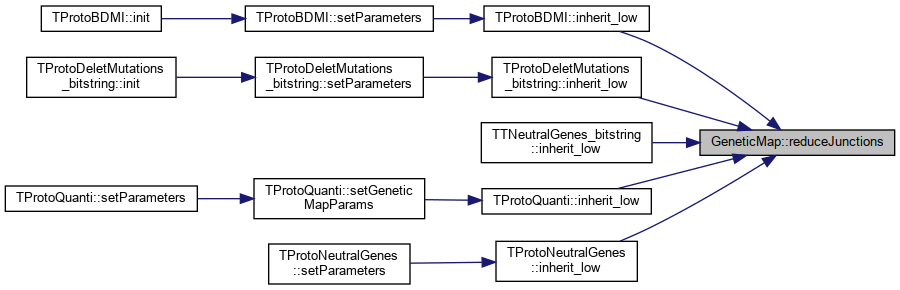
Referenced by TProtoBDMI::inherit_low(), TProtoDeletMutations_bitstring::inherit_low(), TTNeutralGenes_bitstring::inherit_low(), TProtoQuanti::inherit_low(), and TProtoNeutralGenes::inherit_low().

+ Here is the caller graph for this function:
◆ registerIndForRecombine()

bool GeneticMap::registerIndForRecombine ( unsigned long  ID)
inline

Called by TTProtoWithMap::recombine with individual ID passed down from Individual::recombine.

Returns false when already called by the same individual. The function is called for each trait separately but recombination must be computed once per individual only. It is so because some functions create new individual's trait separately, for instance in breed_selection when traits under viability selection are created before neutral traits.

Parameters
IDthe ID number of the individual calling the recombination function
164  {
165  if (ID == _currentIndividual) return false;
166  else _currentIndividual = ID;
167  return true;
168  }

References _currentIndividual.

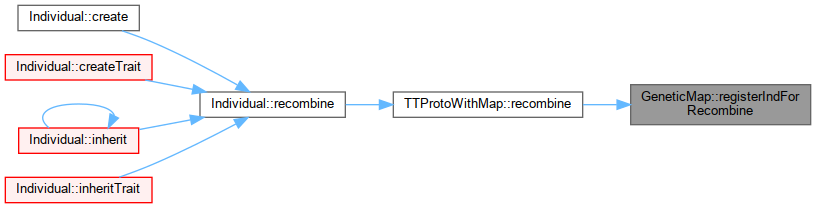
Referenced by TTProtoWithMap::recombine().

+ Here is the caller graph for this function:
◆ rescaleMap()

void GeneticMap::rescaleMap ( double  val)
955 {
956  assert(val < _resolution);
957 
958  double ratio = _resolution/val; //it is assumed that val < _resolution
959 
960  _resolution = val;
961 
962  //we have to update all positions
963  for (unsigned int i = 0; i < _nTrait; ++i) {
964  for (unsigned int j = 0; j < _numLociPerTrait[i]; ++j) {
965  _locPositionsPerTrait[i][j] *= ratio;
966  }
967  }
968 
969  for (unsigned int i = 0; i < _numChromosome; ++i) {
970  _perChrsmLength[i] *= ratio;
971  _chrsmFirstLocusPosition[i] *= ratio;
972  }
973 
974  _totalLength *= ratio;
975  _totRecombEventsMean = (double)_totalLength * 0.01 * _resolution;
976 
977  //reset all lookup tables, the total length has changed!
978  for (unsigned int i = 0; i < _nTrait; ++i) setLookupTable(i);
979 }

References _chrsmFirstLocusPosition, _locPositionsPerTrait, _nTrait, _numChromosome, _numLociPerTrait, _perChrsmLength, _resolution, _totalLength, _totRecombEventsMean, and setLookupTable().

Referenced by addTrait().

+ Here is the caller graph for this function:

◆ reset_tables()

void GeneticMap::reset_tables ( )
1405 {
1406  if(_perChrsmLength != NULL) delete [] _perChrsmLength;
1407  _perChrsmLength = NULL;
1408 
1409  if(_chrsmFirstLocusPosition != NULL) delete [] _chrsmFirstLocusPosition;
1410  _chrsmFirstLocusPosition = NULL;
1411 
1412  _numChrsmPerTrait.clear();
1413  _numLociPerTrait.clear();
1414 
1415  for (unsigned int i = 0; i < _lociLookupTable.size(); ++i) {
1416  if(_lociLookupTable[i] != NULL) delete [] _lociLookupTable[i];
1417  else error("GeneticMap::reset_tables::found null pointer in _lociLookupTable\n");
1418  }
1419  _lociLookupTable.clear();
1420 
1421  for (unsigned int i = 0; i < _numLociPerChrsmPerTrait.size(); ++i) {
1422  if(_numLociPerChrsmPerTrait[i] != NULL) delete [] _numLociPerChrsmPerTrait[i];
1423  else error("GeneticMap::reset_tables::found null pointer in _numLociPerChrsmPerTrait\n");
1424  }
1425  _numLociPerChrsmPerTrait.clear();
1426 
1427  for (unsigned int i = 0; i < _locPositionsPerTrait.size(); ++i) {
1428  if(_locPositionsPerTrait[i] != NULL) delete [] _locPositionsPerTrait[i];
1429  else error("GeneticMap::reset_tables::found null pointer in _locPositionsPerTrait\n");
1430  }
1431  _locPositionsPerTrait.clear();
1432 
1433  _recPositions[0].clear();
1434  _recPositions[1].clear();
1435 
1436  _chrsmFirstRecombPosition[0].clear();
1437  _chrsmFirstRecombPosition[1].clear();
1438 
1439 }

References _chrsmFirstLocusPosition, _chrsmFirstRecombPosition, _lociLookupTable, _locPositionsPerTrait, _numChrsmPerTrait, _numLociPerChrsmPerTrait, _numLociPerTrait, _perChrsmLength, _recPositions, and error().

Referenced by addTrait(), clear(), and ~GeneticMap().

+ Here is the caller graph for this function:

◆ setLookupTable()

void GeneticMap::setLookupTable ( unsigned int  idx)

Bbuilds the lookup table for each trait.

A lookup table maps a chromosomal position to a locus so that when a x-over is placed at a given map position, the corresponding locus can be directly found. The size of the lookup table depends on the _totalLength and _resolution of the map. The lookup table for a 1M map at the 0.01 cM scale will have 10,000 elements.

Parameters
idxthe index of the trait in the table (stored in the trait prototype)

!!! +1 needed here because map must start with 0 !!!!

984 {
985  if(_lociLookupTable[idx] != NULL) delete [] _lociLookupTable[idx];
986 
987  _lociLookupTable[idx] = new unsigned int [_totalLength +1];
989 
990  if(_lociLookupTable[idx] == NULL)
991  fatal("GeneticMap::set lookup table: memory exhausted?\n");
992 
993  //------------------------------------------------------------------------
994  int pre_offset = 0, post_offset = 0, offset;
995 
996 // cout<<"\n-- Genetic map #"<<idx<<":"<<endl;
997 
998  for (unsigned int loc = 0, pos = 0, stride = 0,
999  c = 0; c < _numChromosome; ++c) {
1000 
1001 // cout<<"Chrm "<<c+1<<" ("<<_perChrsmLength[c]<<" ["<<_resolution<<"cM]):\n"<<"{ ";
1002 
1003  loc = stride;
1004 
1005  stride += _numLociPerChrsmPerTrait[idx][c];
1006 
1007  //the map must start with position zero for the first locus with lowest position
1008  pre_offset = -_chrsmFirstLocusPosition[c];
1009 
1010  //chromosomes are contiguous
1011  offset = pre_offset + post_offset;
1012 
1013  for(; loc < stride && loc < _numLociPerTrait[idx]; ++loc)
1014  {
1015 
1016  while (pos <= ( _locPositionsPerTrait[idx][loc] + offset) &&
1017  ((int)pos - post_offset) <= (int)_perChrsmLength[c])
1018  //table has 1 more elmnt, hence "<="
1019 
1020  _lociLookupTable[idx][pos++] = loc;
1021 
1022 // cout << loc<<":"<<pos-1<<"("<<(int)pos - post_offset<<"; tab["<<pos-1<<"]="<<_lociLookupTable[idx][pos-1]<<") ";
1023 
1024  }
1025 
1026  post_offset += _perChrsmLength[c];
1027 
1028  // need to pad to the right when we reached last locus on a chromosome but not at the last map position of that chrm
1029  // this must apply only to all chrm but the last, hence loc < max num loci
1030  while( pos < post_offset && loc == stride && loc < _numLociPerTrait[idx])
1031  {
1032  _lociLookupTable[idx][pos++] = loc;
1033 // cout << loc<<":"<<pos-1<<"(tab["<<pos-1<<"]="<<_lociLookupTable[idx][pos-1]<<") ";
1034 
1035  }
1036 
1037  // we need to pad to the right when position of last locus is within last chromosome (chrom length set by other traits too)
1038  // pad with last locus number+1 (tot num loci) on that chromosome
1039  while (pos < _totalLength+1 && loc >= _numLociPerTrait[idx])
1040  {
1041 
1042  _lociLookupTable[idx][pos++] = _numLociPerTrait[idx];
1043 
1044 // cout << loc<<":"<<pos-1<<"(tab["<<pos-1<<"]="<<_lociLookupTable[idx][pos-1]<<") ";
1045 
1046  }
1047 // cout << "}\n";
1048  }
1049 
1050 
1051 #ifdef _DEBUG_
1052 // map< trait_t, unsigned int>::iterator ITER = _traits.begin() + idx;
1053 
1054  cout << "\nGeneticMap::setLookupTable ("<<idx<<")\n";
1055 
1056  cout << "lookup table: [";
1057  for(unsigned int i = 0; i < _totalLength+1 && i < 101; ++i) {
1058  cout << _lociLookupTable[idx][i] << " ";
1059  if( i == 100) cout << "|>100) ";
1060  }
1061  if(_totalLength >= 100) cout << "... last pos ("<<_totalLength<<") "<<_lociLookupTable[idx][_totalLength];
1062  cout << "] (truncated if > 100 positions)\n";
1063 
1064  pre_offset = 0; post_offset = 0;
1065  for(unsigned int c = 0, stride = 0; c < _numChromosome; c++) {
1066 
1067  cout <<"+++Chrm "<<c+1<<" num loci: "<<_numLociPerChrsmPerTrait[idx][c]
1068  <<" ("<<_perChrsmLength[c]<<" ["<<_resolution<<"*cM]):\n";
1069  cout << "Loc positions: [ ";
1070 
1071  for(unsigned int i = 0; i < _numLociPerChrsmPerTrait[idx][c] && i < 101; ++i){
1072  if( i < 100 || !(i % 100) )
1073  cout << _locPositionsPerTrait[idx][i+stride] << " " ;
1074  if( i == 100) cout << "|>100) ";
1075  }
1076  cout << "]\n";
1077 
1078  pre_offset = -_chrsmFirstLocusPosition[c];
1079  offset = pre_offset + post_offset;
1080 
1081  cout << "lookup table: (from first pos:"<<_chrsmFirstLocusPosition[c]+offset<<") [ ";
1082 
1083  for(unsigned int cnt=0, i = _chrsmFirstLocusPosition[c]+offset;
1084  i < _chrsmFirstLocusPosition[c]+_perChrsmLength[c]+offset && cnt < 100;
1085  ++i, ++cnt){
1086  cout << _lociLookupTable[idx][i] << " " ;
1087  }
1088  cout << "] (first 100 positions only)\nlookup table: {position:locus} (first 100 + 100th) (offset = "<<offset<<", stride = "<<stride<<")\n {";
1089 
1090  for(unsigned int i = 0; i < _numLociPerChrsmPerTrait[idx][c]; ++i) {
1091  if( i < 100 || !(i % 100) )
1092  cout<<_locPositionsPerTrait[idx][i+stride]+offset<<":"<<_lociLookupTable[idx][_locPositionsPerTrait[idx][i+stride]+offset]<<", ";
1093  if( i == 100) cout << "|>100) ";
1094  }
1095  // last locus
1096  cout<<_locPositionsPerTrait[idx][stride + _numLociPerChrsmPerTrait[idx][c]-1]+offset
1097  <<":"<<_lociLookupTable[idx][_locPositionsPerTrait[idx][stride + _numLociPerChrsmPerTrait[idx][c]-1]+offset]<<"}\n";
1098 
1099  post_offset += _perChrsmLength[c];
1100  stride += _numLociPerChrsmPerTrait[idx][c];
1101  }
1102  cout<<endl;
1103 // cout<<"Loc pos lookup table:"<<endl<<"{";
1104 // for(unsigned int i = 0; i < _superChrsmLength; ++i)
1105 // cout<<_recLociPositionTable[i]<<", ";
1106 // cout<<"}"<<endl;
1107 
1108  cout<<" Tot map length: "<<_totalLength<<endl;
1109  cout<<" Mean num recombination events: "<<_totRecombEventsMean<<endl;
1110 #endif
1111 }

References _chrsmFirstLocusPosition, _lociLookupTable, _locPositionsPerTrait, _numChromosome, _numLociPerChrsmPerTrait, _numLociPerTrait, _perChrsmLength, _resolution, _totalLength, _totRecombEventsMean, and fatal().

Referenced by addTrait(), and rescaleMap().

+ Here is the caller graph for this function:

◆ setResolution()

double GeneticMap::setResolution ( double  val)
inline
108  {
109  _resolution = (val < _resolution ? val : _resolution);
110  return _resolution;
111  }

References _resolution.

◆ unregisterTrait()

void GeneticMap::unregisterTrait ( trait_t  trait)
650 {
651  map<trait_t, unsigned int>::iterator tIter;
652 
653  tIter = _traits.find(trait);
654 
655  if ( tIter != _traits.end() ) {
656 
657 // cout<<"GeneticMap::unregisterTrait::"<<tIter->first<<" (idx: "<<tIter->second<<")"<<endl;
658 
659  _traits.erase(tIter);
660 
661  //@TODO trait lookup tables must be erased as well
662 
663 // cout<<"GeneticMap::unregisterTrait::done\n";
664  }
665  else fatal("Genetic map::unregisterTrait: trait \"%s\" is not registered\n", trait.c_str());
666 
667  _nTrait--;
668 }

References _nTrait, _traits, and fatal().

Referenced by TTProtoWithMap::reset(), and TTProtoWithMap::unregisterFromGeneticMap().

+ Here is the caller graph for this function:

Member Data Documentation

◆ _chrsmFirstLocusPosition

unsigned int* GeneticMap::_chrsmFirstLocusPosition
private

◆ _chrsmFirstRecombPosition

vector< bool > GeneticMap::_chrsmFirstRecombPosition[2]
private

Two vectors holding the starting copy of each chromosome to use when creating the two gametes that are used to create a new individual.

Referenced by getFirstRecPosition(), placeRecombinationEvents(), recombine(), reduceJunctions(), and reset_tables().

◆ _currentIndividual

unsigned long GeneticMap::_currentIndividual
private

Referenced by registerIndForRecombine().

◆ _junctions

vector< unsigned int > GeneticMap::_junctions
private

A vector to store the position of the recombination events.

Referenced by placeRecombinationEvents(), and recombine().

◆ _lociLookupTable

vector< unsigned int* > GeneticMap::_lociLookupTable
private

A list of tables that map the map position (cM) to a locus, for each trait.

The length of the table is the length of the genetic map, which depends on the map resolution (cM by default).

Referenced by addTrait(), placeRecombinationEvents(), reset_tables(), and setLookupTable().

◆ _locPositionsPerTrait

vector< unsigned int* > GeneticMap::_locPositionsPerTrait
private

Vector containing the table of map position for the loci of each trait.

Positions are recorded according to the minimum map resolution as used in the lookup table.

Referenced by addTrait(), getGeneticMap(), getLocusPositionTable(), rescaleMap(), reset_tables(), and setLookupTable().

◆ _nTrait

unsigned int GeneticMap::_nTrait
private

Number of traits registered in the map.

Length of following arrays.

Referenced by addTrait(), clear(), placeRecombinationEvents(), recombine(), rescaleMap(), and unregisterTrait().

◆ _numChromosome

unsigned int GeneticMap::_numChromosome
private

◆ _numChrsmPerTrait

vector< unsigned int > GeneticMap::_numChrsmPerTrait
private

Vector of number of chromosomes for each trait.

Referenced by addTrait(), and reset_tables().

◆ _numLociPerChrsmPerTrait

vector< unsigned int* > GeneticMap::_numLociPerChrsmPerTrait
private

Vector containing a table of number of loci per chromosome for each trait.

Referenced by addTrait(), getGeneticMap(), placeRecombinationEvents(), reduceJunctions(), reset_tables(), and setLookupTable().

◆ _numLociPerTrait

vector< unsigned int > GeneticMap::_numLociPerTrait
private

Vector of number of loci for each trait.

Referenced by addTrait(), getGeneticMap(), placeRecombinationEvents(), recombine(), rescaleMap(), reset_tables(), and setLookupTable().

◆ _perChrsmLength

unsigned int* GeneticMap::_perChrsmLength
private

◆ _recombinationRate

double GeneticMap::_recombinationRate
private

Referenced by addTrait().

◆ _recombLength

unsigned int GeneticMap::_recombLength
private

Referenced by addTrait(), and recombine().

◆ _recPositions

vector< vector < unsigned int > > GeneticMap::_recPositions[2]
private

Vector of tables containing, for each trait, the locus number at which x-overs happen.

Updated at each generation. There is matrix per sex/gamete with one trait per row and a variable number of elements in each row.

Referenced by addTrait(), getRecLoci(), placeRecombinationEvents(), recombine(), reduceJunctions(), and reset_tables().

◆ _resolution

double GeneticMap::_resolution
private

◆ _totalLength

unsigned int GeneticMap::_totalLength
private

◆ _totalNumLoci

unsigned int GeneticMap::_totalNumLoci
private

Referenced by addTrait(), and recombine().

◆ _totRecombEventsMean

double GeneticMap::_totRecombEventsMean
private

◆ _traits

map< trait_t, unsigned int > GeneticMap::_traits
private

Table mapping trait type to its position index in the following tables.

Referenced by addTrait(), checkRegisteredTrait(), clear(), getGeneticMap(), getLocusPositionTable(), and unregisterTrait().


The documentation for this class was generated from the following files:

Generated for Nemo v2.4.1 by  doxygen 1.9.1

Catalogued on GSR